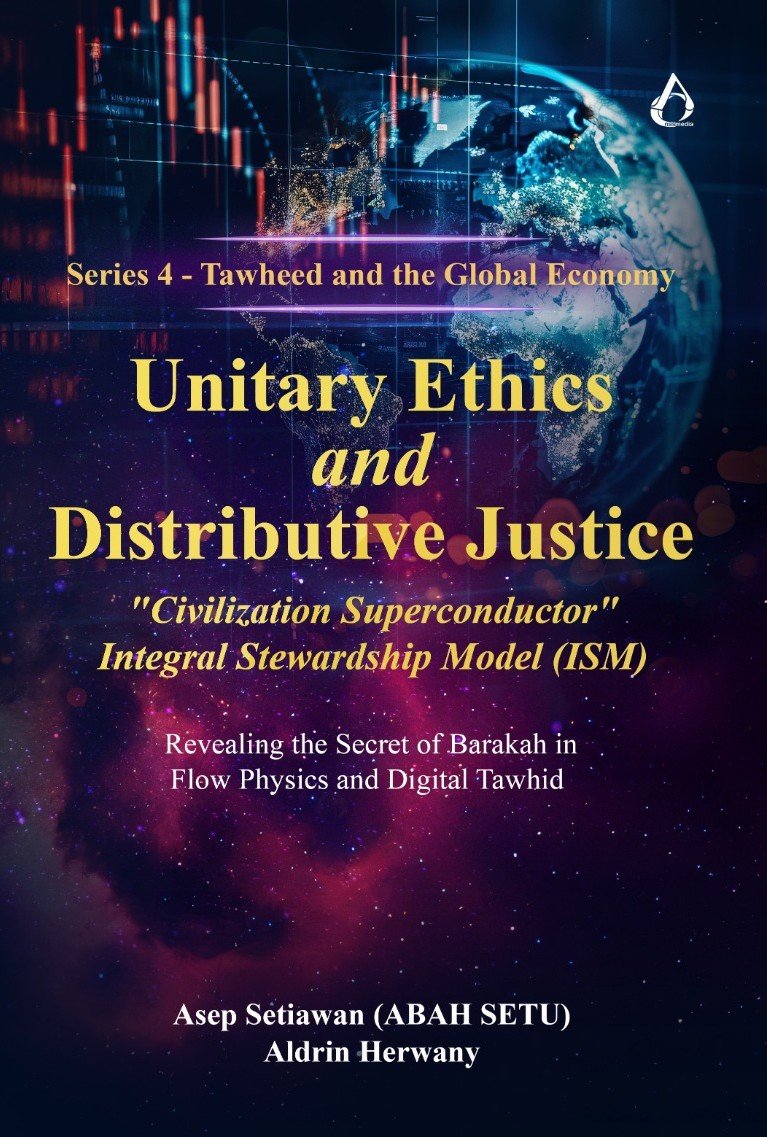
Book
Unitary Ethics and Distributive Justice
Asep Setiawan (Abah Setu) Aldrin Herwany
21 September 2026
PDF Tersedia
Tawheed and the Global Economy: Unitary Ethics and Distributive Justice
"Civilization Superconductor" – Integral Stewardship Model (ISM): Revealing the Secret of Barakah in Flow Physics and Digital Tawheed
Amid unprecedented technological advancement, artificial intelligence, and global capital accumulation, human civilization continues to experience recurring crises: economic inequality, exponential debt, ecological destruction, moral decline, and existential disorientation. This book raises a fundamental question: why has material progress failed to automatically produce justice, well-being, and sustainability?
Series 4 offers an answer by positioning tawheed as the coordinate system of civilization. Tawheed is presented not merely as a theological doctrine, but as a universal principle of unity connecting humanity, nature, economics, technology, and the Creator within a single law of balance. When economic activity becomes disconnected from morality and spiritual responsibility, systems emerge that pursue unlimited growth, concentrate wealth, exploit nature, and generate recurring systemic crises.
Through the concepts of Mizan, Qisth, amanah, falah, halal-thayyib, and distributive justice, this book critically examines the limitations of materialism, interest-based finance, speculation, and the paradigm of absolute ownership. As an alternative, the authors introduce the Integral Stewardship Model (ISM), a civilizational governance architecture that integrates spirituality, ethics, real-sector economics, digital technology, ecological sustainability, and the equitable circulation of prosperity.
The book further bridges tawhidic thought with contemporary science, physics, system dynamics, digital transformation, and global economic governance. The ISM framework is subsequently translated into practical applications through interest-free finance, risk-sharing partnerships, zakat and waqf, green economics, digital trust, and the trust integrity index.
Ultimately, this book is a call for the recalibration of civilization. It invites humanity to move from the illusion of absolute ownership toward responsible stewardship, to restore the economy as an instrument for serving life rather than dominating it, and to build a future grounded in balance, justice, sustainability, and Barakah. It presents Tawhid not only as a spiritual foundation, but as a transformative framework for designing a more resilient and equitable global civilization.
"Civilization Superconductor" – Integral Stewardship Model (ISM): Revealing the Secret of Barakah in Flow Physics and Digital Tawheed
Amid unprecedented technological advancement, artificial intelligence, and global capital accumulation, human civilization continues to experience recurring crises: economic inequality, exponential debt, ecological destruction, moral decline, and existential disorientation. This book raises a fundamental question: why has material progress failed to automatically produce justice, well-being, and sustainability?
Series 4 offers an answer by positioning tawheed as the coordinate system of civilization. Tawheed is presented not merely as a theological doctrine, but as a universal principle of unity connecting humanity, nature, economics, technology, and the Creator within a single law of balance. When economic activity becomes disconnected from morality and spiritual responsibility, systems emerge that pursue unlimited growth, concentrate wealth, exploit nature, and generate recurring systemic crises.
Through the concepts of Mizan, Qisth, amanah, falah, halal-thayyib, and distributive justice, this book critically examines the limitations of materialism, interest-based finance, speculation, and the paradigm of absolute ownership. As an alternative, the authors introduce the Integral Stewardship Model (ISM), a civilizational governance architecture that integrates spirituality, ethics, real-sector economics, digital technology, ecological sustainability, and the equitable circulation of prosperity.
The book further bridges tawhidic thought with contemporary science, physics, system dynamics, digital transformation, and global economic governance. The ISM framework is subsequently translated into practical applications through interest-free finance, risk-sharing partnerships, zakat and waqf, green economics, digital trust, and the trust integrity index.
Ultimately, this book is a call for the recalibration of civilization. It invites humanity to move from the illusion of absolute ownership toward responsible stewardship, to restore the economy as an instrument for serving life rather than dominating it, and to build a future grounded in balance, justice, sustainability, and Barakah. It presents Tawhid not only as a spiritual foundation, but as a transformative framework for designing a more resilient and equitable global civilization.
